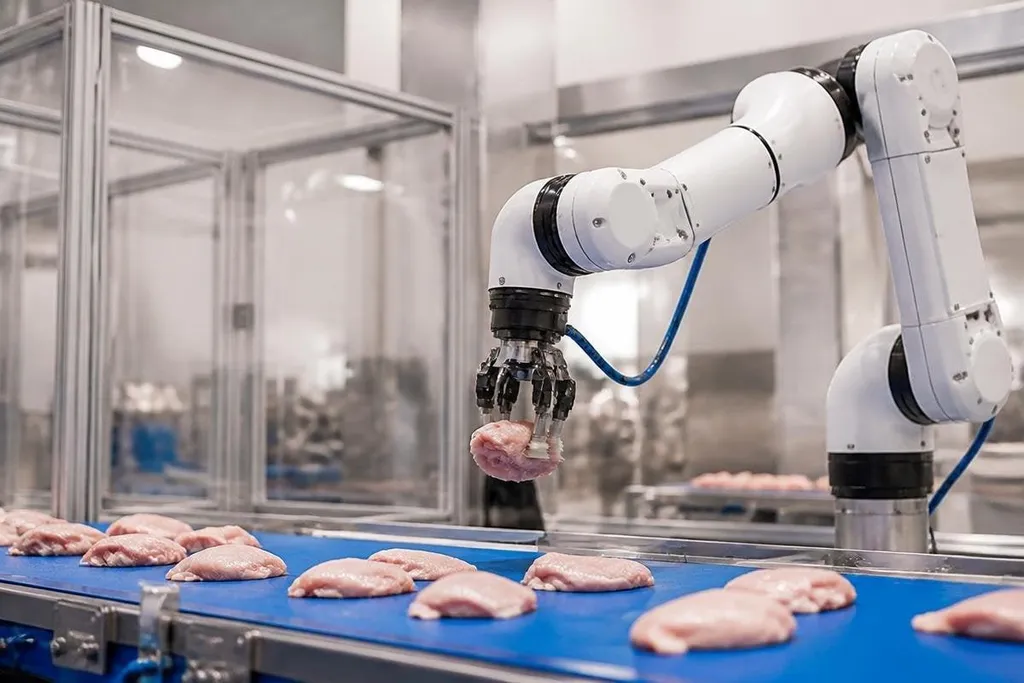
A food robot must handle objects that change shape, size, color, and position. AI helps the robot adjust to those changes, but it still needs clean data, safe hardware, and a clear task.
- Camera software can sort food by size, color, or surface marks.
- A robot arm can change its grip when an item shifts.
- Human checks still matter when food quality or safety is at stake.
How AI changes the robot’s job
A standard robot repeats a planned motion. That works well when every item arrives in the same place.
Food rarely behaves that way. A tomato can roll, a piece of chicken can bend, and a pastry can break under pressure.
AI gives the robot a way to read those changes. The camera records an image, software checks the image against trained patterns, and the robot chooses a position for its gripper. The gripper is the part that holds or moves the food.
This process can happen before picking, during picking, or after handling. One camera may spot a damaged surface before packing. A force sensor may show that the gripper is pressing too hard. The robot can then change its movement or send the item to a separate line.
The value comes from the link between sensing and motion. On its own, a camera only reports what it sees. A robot arm alone only repeats its programmed path. AI connects the image or sensor reading to the next movement.
Sorting and inspection
Food sorting is a clear use for AI because the robot can check many visible features at once. Software may classify items by color, size, shape, or a visible mark, depending on the camera and the training data.
That does not mean the system understands food in the human sense. It matches new images with patterns from earlier examples. A change in lighting, packaging, crop variety, or camera position can reduce the quality of the result.
Inspection also needs a defined rule. A processor must decide which marks matter, which items need a second check, and which items can move on. Without those rules, a high detection rate says little about the cost of missed defects or rejected good food.
Soft fruit can bruise when a gripper uses too much force, so AI picking claims need more than a demo video. Robot24.com’s food processing robotics coverage can show the food type, gripper force, test date, and result behind each claim.
Picking soft and uneven food
Picking is harder when the object can deform. A rigid gripper may crush food, while a light grip may drop it. AI can help choose a grasp point from the camera image, but the mechanical design still sets the limits.
The robot also needs feedback during contact. Force sensing can show when the fingers touch the item. The control system can then reduce pressure, change the arm path, or release the item when the grip becomes unsafe.
These systems work best when the task has a narrow range of food types and conditions. A robot trained on one product may need new data before it handles another product, even when the two items look similar to a person.
The limits buyers should check
AI adds software, cameras, computing hardware, and maintenance work. It also adds questions that a basic repeat-motion robot may avoid. Ask how the system was trained, how staff correct errors, and what happens when the camera cannot classify an item.
The food setting adds hygiene and safety needs. Surfaces must be suitable for cleaning, contact parts may need special materials, and the robot must fit the site’s food safety process. AI cannot fix a gripper that is hard to wash or a layout that blocks human access.
I’d treat an AI claim as unproven until the supplier shows results on your food, lighting, speed, and packaging.
A practical buying checklist
Use these checks before a pilot or purchase:
- Test your product: Run the robot on the real food, including damaged and irregular pieces.
- Check the error path: Watch what happens when the camera misses an item or sees an unknown shape.
- Measure the manual work: Count how often staff must correct picks, reload parts, or clean sensors.
- Inspect food contact parts: Confirm cleaning steps, materials, access points, and replacement times.
- Ask about new products: Find out how much new image data and setup work each product needs.
- Set a pass rule: Choose a target for correct picks, rejected items, cleaning time, and staff checks before testing.
A good system should show where AI changes the task and where ordinary robot control remains enough. The next useful step is a trial with real food and a written pass rule, not a demo built around perfect samples.